Categories
Religious Legal Theory Science and Religion Theology

Law, Neurobiology, and the Soul, Part IV: Neurobiology and the Reported Death of the Soul

Later this week I’m heading to Poland for the “What is Life:  Theology, Science, Philosophy” conference.  It will be a chance to connect with my dissertation adviser, meet some new people, and take in some interesting presentations (and, I hope, enjoy some good Polish food and drink!).  I’m presenting a version of my paper Towards a Critical Realist Theology of Law, Neurobiology and the Soul.  This paper in many ways serves as a sketch of my dissertation project, which I’m sure will change and develop as I proceed.  I’ll post portions of it in this series of posts.  Below is Part IV, and here are links to Part I, Part II and Part III.

Neurobiology and the Reported Death of the Soul

Neuroscience suggests that “the brain is a physical entity governed by the principles and rules of the physical world”,” and that “brain determines mind.”[1] Contemporary neuroscience thereby claims to elide the soul and the mind – what many neuroscientists call “the ghost in the machine.”[2] All of the faculties attributed in Scholastic Christian theology to the “sensitive soul” (“locomotion, appetite, sensation, and emotion”), as well as the intellectual faculties attributed to the human “rational soul,” can or will be accounted for by brain functions.[3] As Martha Farah of the University of Pennsylvania’s Center for Neuroscience & Society puts it, “as neuroscience begins to reveal the mechanisms of personality, character, and even sense of spirituality dualism becomes strained. If these are all features of the machine, why have a ghost at all? By raising questions like this, it seems likely that neuroscience will pose a far more fundamental challenge to religion than evolutionary biology.”[4]

Some contemporary Christian theologians have responded to this challenge by doing away with the soul.  Protestant theologian Nancey Murphy, for example, argues for “nonreductive physicalism” over against traditional notions of the soul.[5] Her colleague at Fuller Seminary, Joel Green, agrees with Murphy, and argues that the Biblical witness tends towards anthropological monism rather than dualism.[6]

For Murphy, Green, and other nonreductive physicalists, “mind” emerges from “brain” in a way that allows “mind” to exercise “downward causality” – the traditional category of the “will.”[7] Thus, the human person is dependent upon, but not wholly determined by, the brain.  Murphy acknowledges that she attempts this non-reductionist move for “theological reasons” having to do with the importance of free will.[8] She notes the concern that reductionists in the neurosciences threaten to “overthrow cherished elements of our self-conceptions,” including notions of “rationality, free will, and moral accountability.”[9] As to the persistence of the person after death, nonreductive physicalists such as Murphy and Green tend to reject any notion of an “intermediate state” of disembodied “soulish” existence.  There is only, to the extent the Christian eschatological hope allows for it, a final resurrection, albeit not one that necessarily involves any continuity with the pre-resurrection body.[10]

Other Christian theologians and philosophers continue to hold to more traditional forms of dualism.  For some, such as philosophers J.P. Moreland, Stewart Goetz, and Charles Landesman, this involves old-fashioned Cartesian substance dualism.[11] In a recent book, Keith Ward draws on philosophical idealism and process philosophy to offer an alternate version of Cartesian dualism.[12] For others, including John Cooper, as well as for many Catholic theologians, it is reflected in a softer “holistic dualism.”[13] Holistic dualism is the teaching of the Catechism of the Catholic Church:  “The unity of soul and body is so profound that one has to consider the soul to be the ‘form’ of the body:   i.e., it is because of its spiritual soul that the body made of matter becomes a living, human body; spirit and matter, in man, are not two natures united, but rather their union forms a single nature.”[14] Still others prefer a notion of “dual aspect monism” to suggest that humans are of one substance (the physical) with two different “aspects,” one of which corresponds to the concept of the “soul.”[15] In holistic dualist or dual aspect monist views, the “soul” is intimately involved with the body, and the intermediate state after death and before resurrection is something less than complete.[16]

As this brief survey suggests, Christian theologians and philosophers seeking to grapple with neuroscience must account for a variety of sources in addition to the scientific, including scripture, tradition, and experience.  They disagree on whether scripture and the Christian tradition, including the important question of disembodied existence after death and prior to resurrection, require dualism of some sort.  They seem to agree, however, that Christian theology requires at least that human beings be understood as possessing some degree of moral agency.


[1] Brent Garland, ed., Neuroscience and the Law:  Brain, Mind and the Scales of  Justice (Dana Press 2004).

[2] See id.

[3] See Nancey Murphy, Bodies and Souls, or Spirited Bodies (Cambridge Univ. Press 2006), at 55-69.

[4] University of Pennsylvania Center for Neuroscience & Society website, available at http://neuroethics.upenn.edu/index.php/section-blog/28-articles/72-science-and-the-soul (last visited March 10, 2010).

[5] Murphy, supra Note 50.

[6] Joel B. Green, Body, Soul and Human Life:  The Nature of Humanity in the Bible (Baker Academic 2008).

[7] Murphy, supra Note 50, at 71-109.  Murphy summarizes here thesis as follows:  “I shall argue that bottom-up causal factors often provide only a partial account of how things work.  One also needs to consider holistic properties of  the entity, as well as the interaction between the entity and its environment.  Thus, I shall argue for top-down or downward causation; this is the thesis that factors at a higher level of complexity have causal influences on the entity’s constituents.”  Id. at 73.

[8] Id. at 72.

[9] Nancey Murphy, Did My Neurons Make Me Do It:  Philosophical and Neurobiological Perspectives on Moral Responsibility and Free Will (Oxford Univ. Press 2009), at p. 2.

[10] See id. at 140-45.  Murphy’s proposal sounds much like a form of eschatological reincarnation:

[A]ll of the personal characteristics as we know them in this life are supported by bodily characteristics and capacities and these bodily capacities happen to belong to a spatio-temporally continuous material object, but there is no reason in principle why a body that is numerically distinct but similar in all relevant respects could not support the same personal characteristics. . . .  My proposal regarding the construal of the ‘same body’ also allows for the possibility of a temporal interval between decay of the earthly body and what is then essentially the recreation of a new body out of different ‘stuff.’

Id. at 141-42.  Green seems to head more in the direction of the Eastern Christian notion of theosis by construing the “intermediate state” between death and resurrection as a kind of direct participation in Christ’s being:

How, then is personal identity sustained from this world to the world-to-come?  On the one hand, Paul locates the answer to this problem under the category of ‘mystery’ (1 Cor 15:51-57).  On the other hand, he hints at a relational ontology — that is, the preservation of our personhood, ‘you’ and ‘me,’ in relational terms:  with Christ, in Christ.  This suggests that the relationality and narrativity that contitute who I am are able to exist apart from neural correlates and embodiment only insofar as they are preserved in God’s own being, in anticipation of new creation.

Green, supra Note 53, at 180.

[11] See J.P. Moreland, Love Your God With All Your Mind:  The role of Reason in the Life of the Soul (NavPress 1997); Stewart Goetz and Charles Taliaferro, Naturalism (Eerdmans 2008); Richard Swinburne, The Evolution of the Soul (Oxford Univ. Press 1986); Charles Landesman, Leibniz’s Mill:  A Challenge to Materialism (Univ. of Notre Dame Press 2011).

[12] Keith Ward, More than Matter:  What Humans Really Are (Lion Hudson 2010).

[13] See, e.g., John W. Cooper, Body, Soul & Life Everlasting:  Biblical Anthropology and the Monism-Dualism Deabate (Eerdmans 2nd ed. 2000); Sherlock, supra Note 47.   Many of these holistic dualists echo, if not explicitly refer to, the Thomistic concept of the soul as the “form of the body.”  Lutheran ethicist Gilbert Meileander summarizes this perspective as follows:

The human person — neither beast nor god — is a real union of body (that ties us to the beasts) and soul (that directs us toward God).  When, however, we try to atriculate what this means (especially in religious terms), we may picture the human person as a composite of two things that are in principle separable, that are temporarily glued together in this life, that will (by God’s grace) be separated in such a way that the person continues to live even after the body has died, and that will one day be reunited (in a resurrected life).  That picture, as appealing as it has been at different times and places, is more dualism than duality.  It does not fully capture our in-betweenness, which is not simply a composite of two essentially different things (such as a horse and rider). . . . Instead of a horse and rider, think of a centaur.

Meileander, Neither Beast Nor God (New Atlantis Books 2009), at 24-25.

[14] Catechism of the Catholic Church, Second Edition, ¶ 365.

[15] N.T. Wright, Surprised by Hope:  Rethinking Heaven, the Resurrection, and the Mission of the Church (HarperOne 2008) , at 28, 199 (stating “[w]e are not saved as souls but as wholes”); John Polkinghorne and Nicholas Beale, Questions of Truth:  Fifty-one Responses to Questions About God, Science and Belief (Westminster John Knox 2009), at 74-77 (stating that “the soul is something logically distinct from our physical bodies, but not a separable physical entity”); Polkinhorne, The God of Hope and the End of the World (Yale Univ. Press 2002), at 103-107.

[16] See, e.g., Wright, supra Note 61; Polkinghorne, The God of Hope, supra Note 61, at 107 (proposing that “a human being could e held in the divine memory after that person’s death.”).

Categories
Religious Legal Theory Science and Religion Theology

Law, Neurobiology, and the Soul, Part III: The Enlightenment and Modern Christian Conceptions of Law

Later this week I’m heading to Poland for the “What is Life:  Theology, Science, Philosophy” conference.  It will be a chance to connect with my dissertation adviser, meet some new people, and take in some interesting presentations (and, I hope, enjoy some good Polish food and drink!).  I’m presenting a version of my paper Towards a Critical Realist Theology of Law, Neurobiology and the Soul.  This paper in many ways serves as a sketch of my dissertation project, which I’m sure will change and develop as I proceed.  I’ll post portions of it in this series of posts.  Below is Part III, and here are links to Part I and Part II.

The Enlightenment and Modern Christian Conceptions of Law

Scholastic Catholic and Magesterial Reformed views of law were often challenged, and sometimes coopted, by the revolutionary fervor of the Enlightenment.  John Witte notes that Enlightenment philosophers such as Hume, Rousseau and Jefferson “offered a new theology of individualism, rationalism, and nationalism to supplement, if not supplant, traditional Christian teachings.”[1] These impulses led to the legal realist school that attempted to divorce law from broad normative concerns and understand it instead as primarily an instrument of political policy objectives.[2]

Although legal realism, and subsequently the critical schools, came to dominate American legal discourse, the Catholic legal tradition continued to develop into a rich tapestry of social teachings, beginning with Pope Leo XIII in the late nineteenth century and particularly blossoming under the historic leadership of Pope John Paul II.[3] Catholic social theory began to focus less on the penal and purgative aspects of the law, but it continued to emphasize the relation between law and metaphysics, including between law and the “soul.”

Thus, for example, Catholic legal philosopher Jacques Maritain considered materialist-reductionist views of the person, such as those held by Bertrand Russell, to be “nonsense.”[4] Maritain described “natural law” as that which is essential to the normality of any thing’s functioning, “the proper way in which, by reason of its specific structure and specific ends, it ‘should’ achieve its fullness of being either in its growth or in its behavior.”[5] Similarly, John Courtney Murray emphasized the differing purposes of law with respect to persons as individuals and as citizens.[6] The purpose of positive law for Murray is not to discipline individual souls for salvation, but rather to ensure that society moves towards its proper moral end of civic virtue.[7] The foundation of society is the person, and the person functions within various institutions, such as the family, religious organizations, professional groups, and voluntary associations.[8] The principle of subsidiarity holds that the state must respect the boundaries of these institutions, and thereby respect the integrity of the person.[9] Positive law, then, takes on a more minimalist function of maintaining public order and ensuring the integrity of these institutions.[10] The philosophical underpinnings of this view remain committed to a thick metaphysical and theological account of personhood.

Protestant legal thought during this period developed in more piecemeal fashion, with divergent strands including Abraham Kuyper’s notions of “common grace” and “sphere sovereignty,” Karl Barth’s almost fideistic rejection of natural theology, Reinhold Niebuhr’s “Christian realism,” and the potent mixture of revivalism, reconstructionism, and confrontationalism that comprised the fundamentalist-evangelical “religious right.”[11]

Niebuhr’s Christian realism in particular served as a bracing tonic against liberal nineteenth-century Protestant anthropology, which owed its progressively optimistic outlook more to Jefferson and Rousseau than to St. Paul.[12] Niebuhr complained that progressive moralists failed to comprehend “the brutal character of the behavior of all human collectives, and the power of self-interest and collective egoism in all inter-group relations.”[13] Although human beings individually are capable of doing some good, human society always tends towards the violent exertion of power.  This creates a fundamental pattern of conflict that cannot be fully overcome, even by those who are influenced by God’s grace.[14] Therefore, societies must use coercive power — the power of government and law backed by force — to achieve rough justice.[15] And because power corrupts, all such exertions of force must be subject to democratic control.[16]

Abraham Kuyper’s ideas about “sphere sovereignty” and “common grace,” meanwhile, offered resources to evangelicals who were seeking by mid-twentieth century to emerge from the foxholes of fundamentalism, as well as to other Christians in the Reformed traditions.[17] Kuyper accepted basic Reformed anthropology, which understood human nature to have been thoroughly corrupted by sin.  However, he held an expansive concept of common grace, by which God holds back the corrupting effects of sin.[18] “To every rational creature,” Kuyper said, “grace is the air he breathes.”[19] He thereby held together the Reformed “antithesis” between natural and regenerate people with the need to find some common ground for constructing social order.  Like Maritain’s conception of subsidarity, Kuyper argued that human beings are granted authority by God to create social structures, and that such authority inheres in various “spheres” of society such as the family and industry — not only, or even primarily, in the state.[20] In fact, Kuyper viewed the state’s authority as “mechanical,” by which he meant “unnatural.”[21] The state exists only to compel order, which would not have been necessary except for sin.[22] Thus, Kuyper famously stated that “God has instituted the magistrates, by reason of sin.”[23]

Summary

This very brief survey (including Part I and Part II) of Christian theological anthropology in relation to law suggests several enduring themes:  (1) human beings are more than physical; (2) human beings are corrupted by sin; (3) “sin” is something other than the “image of God” with which human beings were endowed by the creator; (4) sin affects the interior human life — the “soul” — as well as human social life; and (5) “law” has both interior-personal and exterior-social functions in restraining sin and directing human beings towards God.[24] The next part of this chapter examines how the contemporary neurobiological sciences view the human person, surveys some theological responses to neuroscience, and suggests some resulting points of agreement and points of tension with Christian theories of law.


[1] Id. at 26.

[2] Id. at 27.  See also Brian Tamanaha, Law as a Means to an End:  Threat to the Rule of Law (Cambridge Univ. Press 2006).

[3] See Witte, supra Note 22, at 30.  For a discussion of Pope Leo XIII’s influence, see Russell Hittinger, “Pope Leo XIII,” in Witte and Alexander, eds., The Teachings of Modern Christianity on Law, Politics & Human Nature, Vol. 1 (Columbia Univ. Press 2006).

[4] Patrick Brennan, “Jacques Maritain,” in Witte and Alexander, supra Note 26, at 86 (quoting Jacques Maritain, Man and the State (University of Chicago Press 1951), at 85)).

[5] Id.

[6] Angela Carmella, “John Courney Murray,” in Witte and Alexander, supra Note 26.

[7] Id. at 121.

[8] Id.

[9] Id. at 122.

[10] Id.

[11] See id.

[12] See Davison M. Douglas, “Reinhold Niebuhr,” in Witte and Alexander, supra Note 26.

[13] Id. at 418 (quoting Niebuhr, Moral Man and Immoral Society (Scribner 1932), at xx.).

[14] Id. at 421-22.

[15] Id. at 423-24.

[16] Id.

[17] See Nicholas Wolterstorff, “Abraham Kuyper,” in Witte and Alexander, supra Note 26.

[18] Id. at 311.

[19] Id.

[20] Id. at 313-17.

[21] Id. at 317-18.

[22] Id. at 318.

[23] Kuyper, Calvinism:  Six Lectures Delivered in the Theological Seminary at Princeton (Revell 1899), at 102.

[24] For a good general summary of these themes, see Charles Sherlock, the Doctrine of Humanity (InterVarsity Press 1996).

Categories
Religious Legal Theory Science and Religion Theology

Law, Neurobiology, and the Soul: Part II — Sin, the Soul, and Secular Law

Polish food and drink!).  I’m presenting a version of my paper Towards a Critical Realist Theology of Law, Neurobiology and the Soul.  This paper in many ways serves as a sketch of my dissertation project, which I’m sure will change and develop as I proceed.  I’ll post portions of it in this series of posts.  Below is Part II, and here is a link to Part I.

Sin, the Soul, and the Need for Secular Law

If the rational soul inclines human beings to God, why do we end up with the chaos of Judges 19 when “everyone does as he or she sees fit” and gross violence ensues?  The answer – or at least a significant part of the answer, particularly in Western Christian theology – is sin.  Augustine, in particular, connected the need for a King – secular law – to sin.  Without sin, man would live by the divine law and would not become subject to other men.  Because of sin, men need the scourge and penalty of human law:

And beyond question it is a happier thing to be the slave of a man than of a lust; for even this very lust of ruling, to mention no others, lays waste men’s hearts with the most ruthless dominion. Moreover, when men are subjected to one another in a peaceful order, the lowly position does as much good to the servant as the proud position does harm to the master. But by nature, as God first created us, no one is the slave either of man or of sin. This servitude is, however, penal, and is appointed by that law which enjoins the preservation of the natural order and forbids its disturbance; for if nothing had been done in violation of that law, there would have been nothing to restrain by penal servitude. And therefore the apostle admonishes slaves to be subject to their masters, and to serve them heartily and with good-will, so that, if they cannot be freed by their masters, they may themselves make their slavery in some sort free, by serving not in crafty fear, but in faithful love, until all unrighteousness pass away, and all principality and every human power be brought to nothing, and God be all in all.[1]

The rational soul’s natural inclination towards God and the good, then, is corrupted and must be disciplined by positive law.  The extent of this corruption remains a lively debate in the Christian tradition.  Is reason erased or merely limited by sin?  Catholic, Reformed and Eastern Orthodox thinkers disagree with each other, and often among themselves.[2] Yet all agree that human beings, absent divine grace, are bound to, or at least (in the Eastern tradition) are deeply influenced by, sin.  Indeed, we find this theme embedded in the heart of St. Paul’s theological anthropology in Romans 7:

So I find this law at work: When I want to do good, evil is right there with me. For in my inner being I delight in God’s law; but I see another law at work in the members of my body, waging war against the law of my mind and making me a prisoner of the law of sin at work within my members. What a wretched man I am! Who will rescue me from this body of death? Thanks be to God—through Jesus Christ our Lord!
So then, I myself in my mind am a slave to God’s law, but in the sinful nature a slave to the law of sin.[3]

The interplay of reason, sin, and law is ingrained in the Western legal and ethical tradition.  As Harold Berman traces the trajectory of Western jurisprudence, in the interplay of Roman law with Biblical sources, the canon law came to focus on the role of positive law in preparing the soul for life with God after death.[4] Initially, the Christian theology had little use for temporal law.  Christ was expected to return within the Church’s founding generation, and  “[a]s long as the Last Judgment was understood solely as the inauguration of divine rule in the world to come, imminent or already present, it did not inspire the creation of parallel legal institutions for the interim period on earth.  The vision was essentially apocalyptic rather than prophetic.”[5]

Western Christian thinking began to shift toward the end of the first millennium, however, when it became clear that Christ’s return would not be immediate.  Elaborate doctrines of purgatory and penances were developed by the Church to deal with “ordinary” life in the absence of Christ’s return.[6] Under this system, “sin” took on a legal character, “as specific wrongful acts of desires or thoughts for which penalties must be paid in temporal suffering, whether in this life or the next.”[7] The hierarchy of sins and punishments “was to be established primarily by the moral law revealed by God first in Scripture (divine law) and second in the hearts and minds of men (natural law); but it was to be further defined by the positive laws of the church.”[8]

The resulting legal system heavily emphasized notions of human culpability.  Penitential works became identified with punishment that would expurgate the sinner of taint so that time in Purgatory could be remitted.[9] Penance was a means of God’s vengeance against human rebellion.[10]

These connections between soul and will, and law and penance, led to detailed canon law rules for assessing a criminal’s mental state so that the appropriate punishment could be meted out.[11] The canon lawyers required “a specific inquiry into the mind and heart and soul of the accused.”[12] The canon law required proof of both an intentional act and proof that the external act “revealed a depraved mind and heart and soul,” thus anticipating modern criminal law’s categories of actus rea and mens rea.[13] They developed defenses for wrongful acts committed without requisite malicious intent, for example, as a result of mistake or pursuant to a just reason such as self-defense.[14]

Although the ferment of the Age of Anxiety and subsequently of the Protestant Reformation broke down the explicitly ecclesial and salvific functions of positive law, the tradition that positive law serves to punish and correct intentional behavior persisted.  In the Reformed traditions, law was no longer understood as serving any purgative function.  Indeed, particularly in the Lutheran tradition, “law” was considered antithetical to “grace” in the economy of salvation.[15] Sin could be expurgated only by God’s grace in applying the merits of the Christ’s atoning death to the sinner.  Nevertheless, particularly in Reformed traditions influenced by Calvinism, positive law was understood as part of the sanctification of the elect within the covenant community.[16] John Witte summarizes the Calvinist-Puritan view of positive law as follows:

Every person is a prophet, priest, and king, and responsible to exhort, minster and rule in the community.  Every person thus stands equal before God and before his or her neighbor.  Every person is vested with a natural liberty to live, to believe, to love and serve God and neighbor.  Every person is entitled to the vernacular Scripture, to education, to work in a vocation.  On the other hand, every person is sinful and prone to evil and egoism.  Every person needs the restraint of the law to deter him from evil, and to drive him to repentance.  Every person needs the association of others to exhort, minister, and rule him with law and with love.  Every person, therefore, is inherently a communal creature.  Every person belongs to a family, a church, a political community.[17]

In both the Catholic and Protestant traditions, then, positive law served a penal and restorative function.  Law ultimately was designed to bend the will towards God and to lead the inner person, the “soul,” into fellowship with Him.


[1] Augustine, City of God, Ch. 15.

[2]The Western Christian tradition’s concept of “original sin” holds that all human beings share in the “Fall” of Adam, the first human, and consequently that all humanity is enslaved to sin.  See Alister McGrath, Christian Theology:  An Introduction (Blackwell 2001), at 445-446.   All orthodox Western Christian traditions resist “Pelagianism,” the doctrine taught by the monk Pelagius that human beings could improve themselves and gain salvation and true goodness by their own merit.  However, Catholic thinkers, such as Thomas Aquinas, held that sin did not erase the human capacity for reason.  Human beings, therefore, remain capable of understanding what is right and good according to “natural reason” even after the fall.  All human beings, according to Aquinas, “possess a natural aptitude for understanding and loving God; and this aptitude consists in the very nature of the mind, which is common to all men”  (Summa Theologica, I.93.4.).  The “likeness” of God, however, is a resemblance to God’s glory, which can only be recovered by those who are regenerated by God.  (Ibid.) A person can only “habitually” know and love God through grace.  (Ibid.) People therefore are capable of knowing and doing good, but can only habitually do good through divine grace, and can only become perfect and thereby have the “likeness” of God restored through ultimate divine salvation.

In contrast, Reformed thinkers held that sin thoroughly corrupted human will and reason, albeit without erasing the “image of God” in humanity.  See Donald Bloesch, Essentials of Evangelical Theology (Hendrickson 2006), at 90-92 (summarizing Reformed thought on “total depravity”).  This is stated with Puritanical clarity in the Heidelberg Catechism:

Question 8. Are we then so corrupt that we are wholly incapable of doing any good, and inclined to all wickedness?

Answer: Indeed we are; except we are regenerated by the Spirit of God

Both Catholic and Protestant / Reformed thinkers have always agreed, however, that sin infects all of human life.  Indeed, there has been significant progress in recent years in ecumenical dialogue between Catholics and some Protestants concerning the contentious relationship between original sin, the nature of human depravity, and salvation.  See Joint Declaration on the Doctrine of Justification by the Lutheran World Federation and the Catholic Church (1999), available at http://www.vatican.va/roman_curia/pontifical_councils/chrstuni/documents/rc_pc_chrstuni_doc_31101999_cath-luth-joint-declaration_en.html (last visited March 8, 2010).  The Joint Statement states that:

We confess together that all persons depend completely on the saving grace of God for their salvation. The freedom they possess in relation to persons and the things of this world is no freedom in relation to salvation, for as sinners they stand under God’s judgment and are incapable of turning by themselves to God to seek deliverance, of meriting their justification before God, or of attaining salvation by their own abilities. Justification takes place solely by God’s grace.

Id. ¶ 19.  The Eastern Christian perspective is somewhat different.  For Eastern Orthodoxy, humanity is tarnished by sin, but the essence of human nature cannot be corrupted, because it was created “good” by God.  See James R. Payton, Jr., Light from the Christian East:  An Introduction to the Orthodox Tradition (IVP Academic 2007), at 112-17.  Nevertheless, in the Eastern tradition, “[s]ince our first parents’ original sin . . . human beings suffer from the terrible disadvantage that humankind has a long history of mortality, sin and disobedience. . . .  We thus freely but inevitably fail to live up to our logos — and so fail God.”  Id.. at 114.  A detailed treatment of the Eastern view is beyond the scope of this Chapter, which focuses on the Western theological and legal traditions.

[3] Romans 7:21-25 (NIV).

[4] Harold J. Berman, Law and Revolution (Harvard Univ. Press 1983), at 166-71.

[5] Id. at 169.

[6] Id. at 170.  Berman marks the creation of the All Soul’s Day holiday shortly after the year 1000 as the watershed in changing attitudes about the relationship between temporal and eternal judgment.  Id.

[7] Id. at 171.

[8] Id.

[9] Id. at 172.

[10] Id. Berman quotes an influential eleventh-century tract as follows:  “punishment (poena) is a hurt (laesio) which punishes and avenges (vindicat) what one commits.”  Id. (quoting De Vera et Falsa Poenitentia, chap. 10),

[11] Id. at 185-98.

[12] Id. at 189.

[13] Id.

[14] Id. at 189-90.

[15] See, e.g., Martin Luther, On the Bondage of the Will, available at http://www.ccel.org/ccel/luther/bondage.titlepage.html (last visited March 8, 2010).

[16] See generally John Witte, Jr., The Reformation of Rights:  Law, Religion and Human Rights in Early Modern Calvinism (Cambridge Univ. Press 2007).

[17] Id. at 15.

Categories
Religious Legal Theory Science and Religion Theology

Law, Neurobiology and the Soul: Part I – Introduction

Later this week I’m heading to Poland for the “What is Life:  Theology, Science, Philosophy” conference.  It will be a chance to connect with my dissertation adviser, meet some new people, and take in some interesting presentations (and, I hope, enjoy some good Polish food and drink!).  I’m presenting a version of my paper Towards a Critical Realist Theology of Law, Neurobiology and the Soul.  This paper in many ways serves as a sketch of my dissertation project, which I’m sure will change and develop as I proceed.  I’ll post portions of it in this series of posts.  Here is Part I.

Towards a Critical Realist Theology of Law, Neurobiology and the Soul

The neurosciences present fundamental challenges to traditional religious conceptions of the nature and functions of positive law.  These challenges stem from the deep revolution the neurosciences promise for our understanding of the nature of the “self.”  For many neurobiologists, the “self” is reducible to natural history, physics, and brain chemistry.  We are nothing more than the impulses of our brains.  At most, human “will” is an emergent property of the brain that allows us to choose among some set of evolutionary strategies.

Some contemporary legal theorists seek to tie the neurobiological understanding of the “self” to theories of positive law.  In their view, positive law is entirely a social construction shaped by sociobiology.  Normative notions of “justice,” “intent,” and “retribution,” for them, are somewhat archaic.  Positive law is best understood as an instrumentalist tool for calibrating behaviors that are construed by various social groups to benefit the group.  Any notion of a deeper ethical basis for law is elided as superfluous.  As noted philosopher Michael Ruse succinctly frames this view, “Ethics is a collective illusion of the genes, put in place to make us good cooperators.  Nothing more, but also nothing less.”[1]

This paper summarizes the challenges neurobiology presents to Christian theories of positive law, and suggests a way forward.  It begins by summarizing the Western Christian tradition’s tight linkage between theological anthropology and theories of positive law.  It next discusses the contemporary Christian theological engagement with neurobiology, which is surprisingly diverse.  The discussion then turns to points of convergence and divergence between Christian and neurobiological accounts of law and personhood.  It concludes with an outline of a methodological proposal for constructive engagement between Christian theories of law and the neurosicences.

Christianity, the Soul, and the Functions of Positive Law

The Soul in the Patristic Tradition

Throughout the Christian intellectual tradition, the “self” historically has been conceived of as multivocal and persistent.[2] The “soul” or the “spiritual” nature of human beings distinguished human from animals and rendered humans eternally accountable to God.

For Athanasius, for example, the soul was the seat of rationality and the nexus between the human person and divine law.  As Athanasius said in his early fourth century treatise Contra Gentes, “the rational nature of the soul is strongly confirmed by its difference from irrational creatures. For this is why common use gives them that name, because, namely, the race of mankind is rational.”[3] Because of the  rational soul, human beings, and only human beings, become amenable to law.  Athanasius notes that

the body is not even constituted to drive itself, but it is carried at the will of another, just as a horse does not yoke himself, but is driven by his master. Hence there are also laws for human beings to practise what is good and to abstain from evil-doing, while to the brutes evil remains unthought of and undiscerned, because they lie outside rationality and the process of understanding. I think then that the existence of a rational soul in man is proved by what we have said.[4]

Likewise, Augustine emphasized the link between the rational soul and Divine law.  For Augustine, as for Athanasius, the rational soul distinguished humans from brute animals, enabling humans to seek transcendent knowledge.  Yet the soul requires discipline.  “[O]wing to the liability of the human mind to fall into mistakes,” Augustine warned, “this very pursuit of knowledge may be a snare to him unless he has a divine Master, whom he may obey without misgiving, and who may at the same time give him such help as to preserve his own freedom.” [5] Therefore, a mortal person “walks by faith, not by sight,” and “refers all peace, bodily or spiritual or both, to that peace which mortal man has with the immortal God, so that he exhibits the well-ordered obedience of faith to eternal law.”[6]

These examples from Athanasius and Augustine reflect a broad theme in the Christian tradition:  the rational soul is the seat of the intellect and the will, and it naturally impels human beings towards God’s law.  Human beings, however, do not obey God’s law.  The familiar refrain of the Biblical Book of Judges highlights what happens when the legitimacy of secular law is eroded:  “In those days Israel had no king; everyone did as he saw fit.”[7] As modern people, we are inclined affirm this as good, but as the story of the Levite and his concubine in Judges 19 makes clear, the fruits of this circumstance are betrayal, rape, oppression and violence.[8]


[1] Michael Ruse, Evolutionary Ethics Past and Present, in Philip Clayton and Jeffrey Schloss, eds., Evolution and Ethics:  Human Morality in Biological and Religious Perspective  (Eerdmans 2004).

[2] For a brief historical survey of Christian doctrine concerning the soul, see John W. Cooper, Body, Soul & Life Everlasting (Eerdmans 1989), at 7-13.  For a discussion of the “immortality of the soul” in early Christian thinkers and the relation of that doctrine to Greek philosophy, see Jaroslav Pelikan, The Christian Tradition:  A History of the Development of Doctrine, Vol. 1, The Emergence of the Catholic Tradition (100-600) (Univ. Chicago Press 1975), at 47-52.

[3] Athanasius, Against the Heathen (Contra Gentes), available in the Christian Classics Ethereal Library at http://www.ccel.org/ccel/schaff/npnf204.vi.html,  at  ¶ 31.

[4] Id., ¶ 32

[5] Augustine, City of God, Ch. 14.

[6] Augustine, City of God, Ch. 14.

[7] Judges 25:21 (NASB).

[8] Judges 19 tells the story of “a certain Levite staying in the remote part of the hill country of Ephraim.”  Judges 19:1.  The man’s concubine cheats on him and then runs away to her father.  Judges 19:2. The man goes after her, and on the return journey, he and the concubine receive hospitality in the home of an old man, also from the hill country of Ephraim, near the Benjamite city of Gibeah.  That evening, “certain worthless fellows” pound on the door and demand to have sex with the man — in a clear echo of the story of the demands made upon Lot in Sodom.  Judges 19:22-25;  cf. Genesis 19:1-11.  Like Lot, the old man in Judges 19 offers the men his virgin daughter, as well as his guest’s concubine.  Judges 19:24.  The men savagely rape the concubine until morning, and she dies.  Judges 19:25-29.  The Ephraimite traveler cuts her body into twelve pieces and sends them “throughout the territory of Israel.”  Judges 19:29-30.   The other tribes subsequently band together and destroy the Benjamites.  Judges 20.  The other tribes realize, however, that the decimated Benjamites will not be able to reconstitute themselves as a duly chastened tribe, so they raid a village that failed to participate in the civil war, kill its inhabitants except for virginal girls, and permit the Benjamites to kidnap the girls for wives.  Judges 21:1-24.  There are many layers to this story, but one of its main themes is summed up by the concluding verse in Judges:  “[i]n those days there was no king in Israel; everyone did what was right in his own eyes.”  Judges 21:25.

Categories
Daybook Spirituality

Daybook: Week of June 19, 2011

With this post, I’m rebooting my Daybook.  Obviously, I failed to keep it going every day.  Perhaps I can do better making it a weekly entry.  So here goes….

Scripture for the Week

Song of Songs 1-2

Reflection

This week’s Reflection is from Divine Eros:  The Hymns of St. Symeon the New Theologian.

What is this spine-chilling mystery that is being accomplished
in me?
In no way can a word recount, nor can
my miserable hand write to the praise and glory
of Him Who is above praise, of Him Who is beyond telling.
For, tell me, if the things now being accomplished in me the
profligate
are inexpressible and unutterable, how would
He Who is the author and maker of such wonders
need praise from us, or need to receive glory?
No, for He Who has been glorified cannot be glorified,
in the same way that the sun that is seen by us in the cosmos
could not be illumined nor partake of light;
the sun gives light, it is not enlightened; it enlightens, it does
not receive light.
For the sun has the light that it received from the beginning,
from the Creator.
And so if God, the Creator of everything, has made the sun,
and has created without need, only to bring to light a
bounteous flame,
and in no way from any other greater need,
how would He receive glory from lowly me?

Categories
Law and Policy

How Christianity Shaped our Founding Documents?

I recently saw a notice from a local church promoting “a new series called Sermons that Shaped America. It’s a look back in history to understand how Christianity helped shape our Founders as well as our early public documents.” The first sermon will feature an interview with a conservative Republican Congressman who represents the church’s district.

Thankfully this isn’t something that would happen at my church.  I suspect that an interview with a Congressman of either political party during a worship service is not something the founders of the New Testament Church — the folks we Christians should really consider “our Founders” — would have found sanguine.  Indeed, I think the writer of John’s Apocalypse would have had a nasty metaphor or two on offer (consorting with the Whore of Babylon, perhaps?).

But what about the broader claim suggested by this sermon series?  Were America’s founding documents shaped by Christianity?

I’ve had the opportunity to study this question, both as a lawyer and as an undergraduate (my history thesis project was on the philosophical roots of the U.S. Constitution).  My answer is that our founding documents surely were “shaped by” Christianity, in the sense that everything in 18th Century America participated in or responded to a culture of  Calvinist-evangelical protestantism.  However, the key documents (including the Declaration of Independence and the Constitution) were most directly informed by Enlightenment liberal political thought derived from John Locke and related sources, most of which was not particularly “Christian.”

I coincidentally received yesterday a copy of a new book by Messiah College historian John Fea, Was America Founded as a Christian Nation?  A Historical Introduction (WJK 2011).  From a brief review, I think Fea offers a wonderfully fair and balanced account of the people and documents that shaped the Republic — and along the way, provides helpful instruction on what it means to think historically.  I wish every preacher tempted to offer a sermon series on the American founding would read it.

A good example is Fea’s discussion of the Declaration of Independence.  According to Fea, the Declaration was not originally a grand, novel statement about human rights.  It was a “foreign policy document” intended to justify America’s place in the community of European nations, all of which already subscribed to the general statements about human rights (meaning, of course, the rights of white males) in the Declaration.  The Declaration only became a more broad “human rights” document later in the nation’s history (for example, in the hands of Abraham Lincoln during the Civil War).  Ironically, the Declaration is a such a grand statement today only because it is a “living” document.

What about the references to God in the Declaration (it refers to “Nature’s God,” the “Creator,” and the “Supreme Judge of the World” and “divine Providence”)?  These are neither “Christian” nor “Deist” references.  They do not incorporate Christianity’s Triune God or any reference to Christ, but they refer to God as “Judge” in a way that suggests something more than Deism’s indifferent watchmaker.  They can properly be considered, Fea suggests, as generally theistic references that are consistent with the broad presuppositions of most 18th Century Americans and Europeans.

The Declaration was neither a “Christian” document nor a “secular” or “Deistic” one.  It was a foreign policy statement that reflects the complex and broadly theistic culture of its day.  This sort of conclusion isn’t satisfying to polemicists on either side of the culture wars.  It doesn’t “preach.”  But it does bear the virtue of truth, which is ultimately more interesting and edifying than propaganda.

Categories
Uncategorized

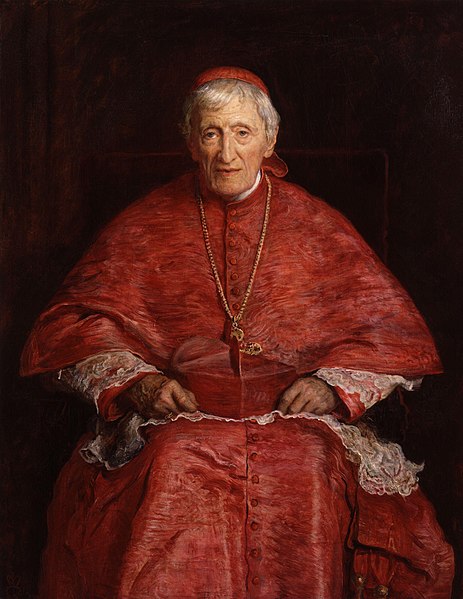
Newman, Barth, and Natural Theology

Recently I had the pleasure of participating in a Seton Hall faculty seminar on Cardinal Newman, sponsored by the University’s Center for Catholic Studies and Center for Vocation and Servant Leadership.   Newman, a convert to Catholicism from the Anglican Church, was the leading Catholic intellectual of the 19th Century.  The seminar was led by Notre Dame’s Cyril O’Regan.  It was an absolute joy.  Participants were encouraged to submit a 1000-word reflection on Newman.  Here’s my contribution to the seminar proceedings


Newman, Barth, and Natural Theology

Newman’s religious epistemology in A Grammar of Assent can strike the contemporary reader as unduly focused on loneliness, fear, and judgment.  His “first lesson” of natural religion is the absence and silence of God.[1] Indeed, “[n]ot only is the Creator far off,” he suggests, “but some being of malignant nature seems . . . to have got hold of us, and to be making us his sport.”[2] All religions, Newman argues, understand that humans are separated from God, and seek to find respite from God’s judgment through prayer, rites of satisfaction, and the intercession of holy men.

The preparation for revealed religion, in Newman’s estimation, is a sense of foreboding – a sense that seems quite distant from the appeal to symmetry and aesthetics that characterized Aquinas’ Five Ways.  It is also far distant, as Newman acknowledges, from the mechanistic remonstrations of William Paley’s watchmaker.  While Paley’s God – and perhaps, in Newman’s estimation, Thomas’ God – could turn out to be any sort of master tinkerer, merely a Platonic ideal of the Victorian gentleman naturalist, the God prefigured by Newman’s natural religion must be more viscerally terrible.  For Newman, “[o]nly one religion,” Christianity, supplies a God capable of dishing out, and absorbing, this sort of pain.

Newman’s focus on anxiety seems to prefigure the existentialist theologies that would come to define the twentieth century, particularly those of Karl Barth and Hans Urs von Balthasaar.  But Newman was more an Augustinian than Barth or Balthasaar, particularly in his construction of revelation and authority.  For Newman, the bulwark of revealed religion was the institutional infallibility of the Roman Church.  Yet even here Newman recognized a dynamic aspect to the Church’s authority.  The decisions of Popes and Councils, he recognized, were often mired in jealousies and politics.[3] Still, the Church reached its conclusions over time spans measured in hundreds and thousands of years.  Time, and patience, and the slow work of God’s Spirit, ensured that the Church would preserve the truth against the vicissitudes of intellectual fashions.

Karl Barth’s theological anthropology, and his resulting appraisal of the “natural” human condition, was remarkably consonant with Newman’s.  For Barth, following Luther, Humanity stood separated from a hidden God.  And Barth repeatedly affirmed that “there is no possibility of dogmatics at all outside the Church.”[4] It might seem that Barth and Newman were following similar lights.

However, Barth was notoriously less sanguine – indeed, not at all sanguine – about the possibility of any sort of natural theology.  He refused any prior anthropological basis for theology.  Moreover, because, in Barth’s view, dogmatics always is a fresh encounter with revelation, he likewise would not assign the final say to any person within or document produced by the Church.  The Roman Catholic approach to dogmatics, even when it understood the Church’s teaching office to embody genuine progress over time, “fails to recognize the divine-human character of the being of the Church.”[5] According to Barth, “[t]he freely acting God Himself and alone is the truth of revelation . . . only in God and not for us is the true basis of Christian utterance identical with its true content.  Hence dogmatics as such does not ask what the apostles and prophets said but what we must say on the basis of the apostles and prophets”[6]

It is curious that Barth does not cite Newman in this section of the Dogmatics.[7] More similarities perhaps appear between this section of the Dogmatics and Newman’s construal of Church authority than otherwise meet the eye.  Newman’s discussion of the “tyrannical interference” that results when the Church acts too swiftly against an apparently new opinion resonates with Barth’s understanding of the “divine-human” Church.[8] If Christian belief and practice has varied since the inception of the Church, for Newman, this only reflects “the necessary attendants on any philosophy or polity which takes possession of the intellect and heart, and has had any wide or extended dominion.”[9] Great ideas can only be fully comprehended over time, particularly when communicated through human media to human recipients, even though transmitted “once for all by inspired teachers.”[10]

Nevertheless, Newman ultimately sides with history over experience:  “[t]o be deep in history,” he said, “is to cease to be a Protestant.”[11] For Barth, revelation is ever and again (to use a Barthian turn of phrase) a fresh encounter with Christ, scripture, and the proclamation of the Church; for Newman, revelation is complete, and what remains is only the development of the Church’s understanding and possession of what has been delivered.  Yet Newman and Barth seem to agree that natural theology, at most, highlights God’s hiddenness.  Nature tells us nothing about God except that God is beyond us, terrible and unreachable.

Is there space for natural theology between the poles of revelation-disclosed-in-history (Newman) and revelation-disclosed-in-experience (Barth)?  Newman rejected the Anglican via media, which, as Newman described it, sought to “reconcile and bring into shape the exuberant phenomena under consideration by cutting off and casting away as corruptions all usages, ways, opinions, and tenets, which have not the sanction of primitive times.”[12] This position of “neither discarding the Fathers nor acknowledging the Pope,” Newman thought, cannot resolve hard cases.[13] However, splitting the difference between history and experience is not the only possible “third way.”  Perhaps Newman’s “natural religion,” although it pointed towards the cross and the Resurrection, did not fully account for the cross and the Resurrection in the history of creation.

The suffering and separation of creation – our suffering and our separation from God – was taken up and transformed by the cross of Christ.[14] The cross reveals that the Logos who created the universe is the suffering servant who became incarnate, God and man, and who in the flesh of man suffered for us and with us.  In the cross and Resurrection, God is not distant or hidden – indeed, in the cross and Resurrection, the shape and purpose of creation is disclosed.  In the cross, history and experience join together; in the Resurrection, history and experience are fulfilled.  Through the cross and the Resurrection, we recognize in creation the love and beauty of the God who declared the universe “good,” the God who made us, and who accepts us by grace despite our sin.  Because the cross and the Resurrection are the center of history and experience, we can delight in creation as gift and know God in creation as the giver of all good gifts.  This is true “natural” theology.


[1] A Grammar of Assent, p. 301.

[2] Ibid., p. 302.

[3] See Apologia Pro Vita Sua, p. 232-33.

[4] Karl Barth, Church Dogmatics (T&T Clark Study Edition2009) (hereinafter “CD”), I.1.3., at p. 17.

[5] CD 1.1.2, at p. 14.

[6] CD I.1.2, at p. 15.  It follows for Barth, then, that “the place from which the way of dogmatic knowledge is to be seen and understood can be neither a prior anthropological possibility nor a subsequent ecclesiastical reality, but only the present moment of the speaking and hearing of Jesus Christ himself, the divine creation of light in our hearts.”  CD I.1.2, at p. 41.

[7] He cites Diekamp, Katholic Dogmatik, 6th ed. (1930).  See CD, I.1.1, at p. 14.

[8] Apologia, at p. 232-33.

[9] Ibid. at 67.

[10] Ibid.

[11] Newman, An Essay on the Development of Christian Doctrine, in Conscience, Consensus, and the Development of Doctrine (Doubleday 1992), at p. 50.  “And whatever history teaches, whatever it omits, whatever it exaggerates or extenuates, whatever it says and unsays,” Newman said, ”at least the Christianity of history is not Protestantism.  If ever there were a safe truth, it is this.”  Id. at 50.

[12] Ibid. at. 52.

[13] Ibid. at 53.

[14] See Jurgen Moltmann, The Crucified God (Fortress Press 1972).

Categories
Photography and Music

New Song: My Spirit Looks to God Alone

Here’s a new arrangement and recording of an old hymn from the Sacred Harp:  “My Spirit Looks to God Alone”  (Sacred Harp #26).  The lyrics were written by the famous hymn writer Isaac Watts in 1719, and are based on Psalm 62.  The arrangement in the
Sacred Harp is based on the Samaria tune.  My arrangement is simple — voice and acoustic guitar, with a little synth padding, and some gongs.  I thought the gongs added a nice, meditative touch to this somewhat somber yet hopeful song.

Categories
Science and Religion Spirituality Theology

God in Creation: Trinity

The third in my series is up on BioLogos.  This one is one the significance of the doctrine of the Trinity for our understanding of creation.  I close the post with this little prayer, which is my prayer for you and me for this day:

Today may you receive with gratitude the gift of being;
May you delight in life;
May you bathe in beauty;
May you know you belong;
May you realize the true measure of your worth,
and share in the joyful dance of God’s overflowing, creative love.

Categories
Spirituality

Nouwen on Centering and Approval

Here is a gem from Henri Nouwen’s The Inner Voice of Love:  A Journey from Anguish to Freedom:

It can be discouraging to discover how quickly you lose your inner peace.  Someone who happens to enter your life can suddenly create restlessness and anxiety in you.  Sometimes this feeling is there before you fully realize it.  You thought you were centered; you thought you could trust yourself; you thought you could stay with God.  But then someone you do not even know intimately makes you feel insecure.  You ask yourself whether you are loved or not, and that stranger becomes the criterion.  Thus you start feeling disillusioned by your own reaction.

Don’t whip yourself for your lack of spiritual progress.  If you do, you will easily be pulled even further away from your center.  You will damage yourself and make it more difficult to come home again.  It is obviously good not to act on your sudden emotions.  But you don’t have to repress them, either.  You can acknowledge them and let them pass by.  In a certain sense, you have to befriend them so that you do not become their victim.

The way to “victory” is not in trying to overcome our dispiriting emotions directly but in building a proper sense of safety and at-homeness and a more incarnate knowledge that you are deeply loved.  Then, little by little, you will stop giving so much power to strangers.

Don’t be discouraged.  Be sure that God will truly fulfill all your needs.  Keep remembering that.  It will help you not to expect that fulfillment from people who you already know are incapable of giving it.