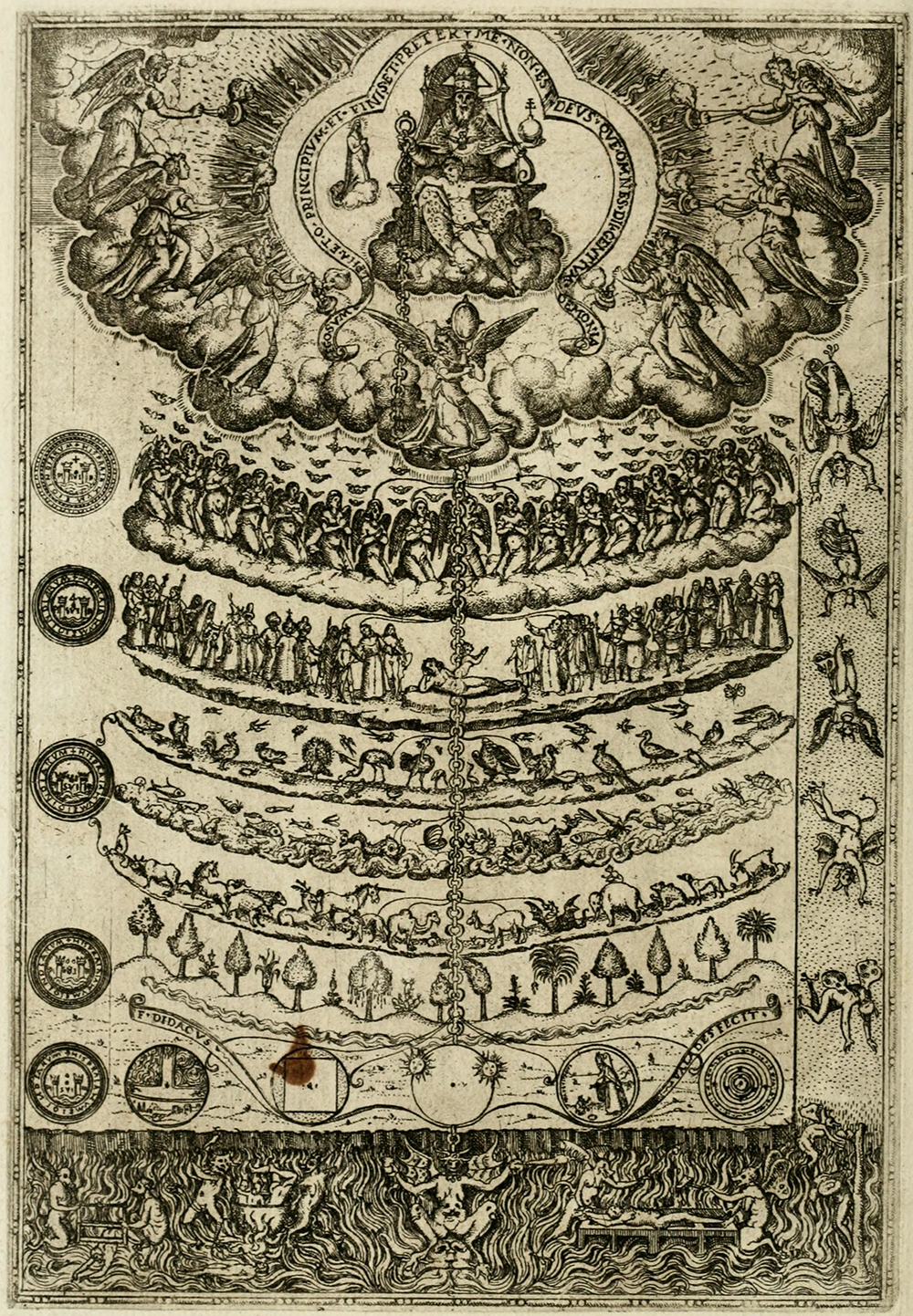
Introduction
What is “life?” Does “life” — human, plant, animal, or other — have a purpose? Are inanimate things in any sense “alive?” A Christian doctrine of creation suggests that “life” is special, imparted by and in some way participating in God, and destined for God’s good purposes. Medieval Christian thought proposed a “Great Chain of Being,” in which each created thing had its purpose and place.
The modern natural sciences exclude teleology (purpose) — or at least that is the received wisdom. Some contemporary voices in theology and science try to demonstrate teleology in nature through empirical evidence of “intelligent design.” We will suggest that both the exclusion of teleology from reflection on nature and the effort to tease out teleology through “scientific” evidence of “intelligent design” are equally misguided. One key problem is a failure to recognize final causes — that to which everything is being drawn — as part of a rich picture of teleology and causation.
At the same time, when we ask about “life” we must ask about “death.” Why is there suffering and death in the cosmos? The problem of evil is one of the great mysteries, which no theology or philosophy can fully penetrate. We will discuss some approaches Christian theology might take to this problem, and contrast them with a-theistic and naturalistic perspectives.
Reading
McGrath, Chapter 4
Oliver, Chapter 3
Wirzba, Chapter 2
Science Matters, Chapter 15, 16, 18